
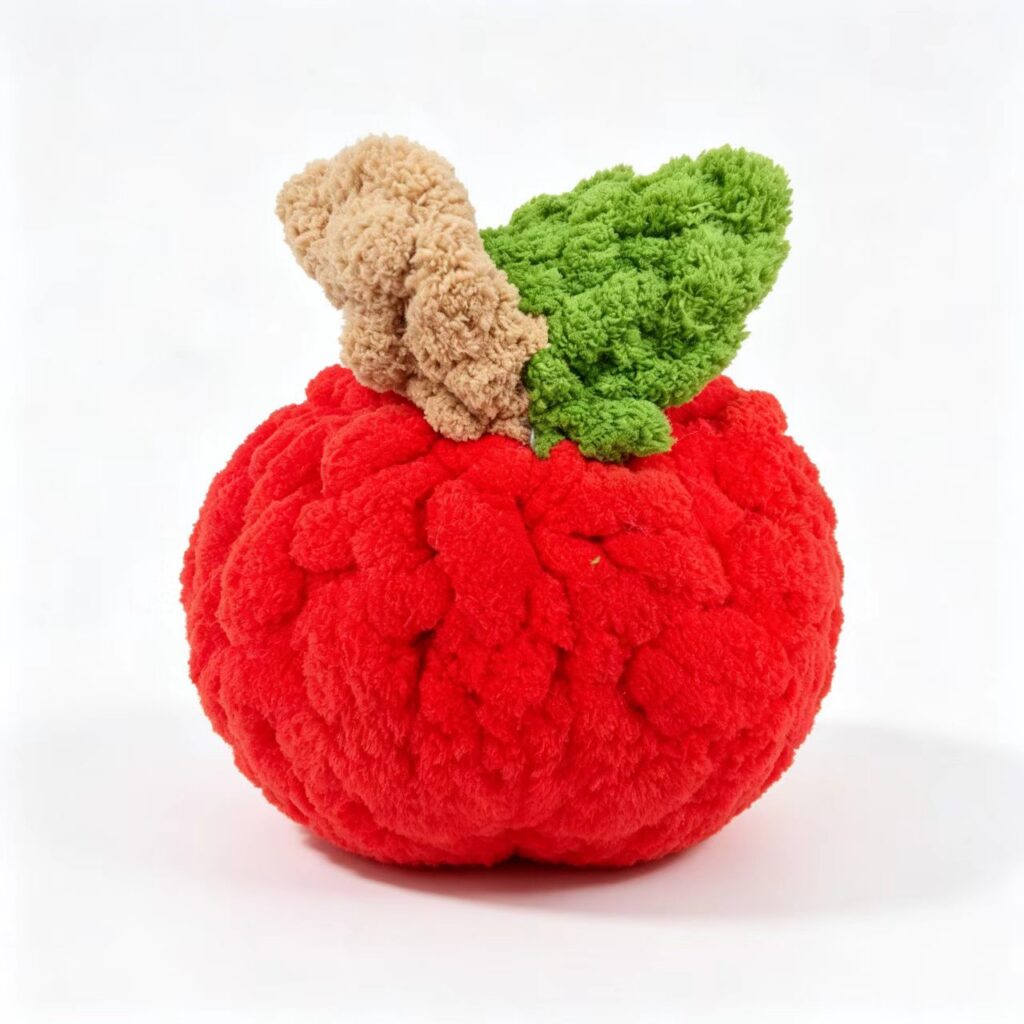
For an apple-shaped throw pillow enquiry, confirm the measurement edges before comparing a sample with the catalogue size. Youxin lists its Red Apple-Shaped Plush Throw Pillow at Diameter 30cm and Height 25cm. Those are supplier catalogue values; the page does not state whether the height includes the leaf and stem or how the rounded body is positioned when measured. Ask for a labelled measurement reference for the offered sample.
Official apple pillow appearance reference. The photograph shows the body and decorative top, but does not supply measurement endpoints or verify the catalogue dimensions.
Keep the catalogue dimensions and their meaning separate
The Red Apple-Shaped Plush Throw Pillow page identifies a red apple form with a decorative top. Its specification text states Diameter 30cm and Height 25cm. A purchasing team can preserve those values exactly in an enquiry while opening a separate field for the supplier’s measuring method. This prevents an unstated interpretation from becoming part of the order.
A height described in a catalogue can refer to different endpoints on an irregular decorative product. Here, the top of the red body and the top of the leaf are visibly different reference points. Neither the photograph nor the wording resolves which one controls the listed height. Ask the supplier to mark both endpoints on the offered product reference instead of assuming the tallest visible detail is included.
Ask what diameter means for this rounded shape
The apple form is rounded rather than a flat circular panel. A useful diameter question therefore names the direction and endpoints. Ask whether the catalogue diameter describes the widest outside span of the body in the specified position, or another reference defined by the supplier. The buyer should not invent an alternative dimension from the image or treat a curved-surface tape path as equivalent to an outside span.
Request a simple front reference and, where useful, a second view showing the proposed span. Keep the stated unit attached to each value. A photograph with a scale can support the discussion when its endpoints and product identity are clear, but an unlabelled ruler beside a rounded cushion may still leave the intended measurement unresolved. The purpose is a repeatable reference for both parties, not a claim that the catalogue value has already been independently verified.
Dimension question | Catalogue starting point | Reference to request
Body span | Diameter 30cm | Marked direction and outside endpoints
Vertical height | Height 25cm | Bottom and top points, including or excluding decoration
Product condition | Not described in the dimension line | Position and condition used for the sample reading
Acceptance range | No tolerance stated | Supplier proposal for buyer agreement
Identify the leaf and stem without changing the product
Alternate official gallery view for identifying the body, leaf and stem. Their visible positions do not define whether they are included in the listed height.
The decorative top matters to this measurement discussion because it extends beyond the rounded body. Label those visible features in the enquiry so that the supplier understands which question is being asked. Do not assume that the leaf’s angle is fixed in every piece or that it can be folded for packing simply because it appears soft. Any proposed presentation or packing position should be confirmed separately.
If a buyer needs a maximum display envelope for shelving or presentation, describe that as a separate requirement. It may differ from the supplier’s named body dimension. Keeping the two fields separate allows the supplier to answer the actual display-space question without silently redefining the catalogue height. No display-fit assurance should be made until the offered product and the required envelope have been compared on an agreed basis.
Use one agreed condition when reviewing the sample
State how the identified sample is positioned during the measurement review. A rounded filled product may be presented upright, resting on a side or in another position; those views are not automatically interchangeable. Ask the supplier to specify the condition used for its dimensions and agree how the buyer will record the corresponding reading. Do not introduce a compression load, recovery time or tolerance that the supplier has not supplied.
• Retain the exact catalogue title, product link and nominal centimetre values.
• Ask for diameter direction and height endpoints on a labelled reference.
• Clarify whether the leaf and stem are inside or outside the height definition.
• Connect the method and any agreed acceptance range to the identified sample.
Record an unresolved dimension as a question rather than a failed sample. Until the measuring method is aligned, two different readings may be describing different spans. If the supplier proposes a revised nominal size, preserve that revision beside the original reference so purchasing and merchandising can see which value belongs to the current offer.
Keep the underside view in its proper role
Official underside appearance reference. It helps identify the product view but is not a measured cross-section or evidence of a particular filling performance.
The underside view can help explain where the pillow rests during a proposed height reading. It cannot reveal the actual diameter or a hidden internal specification. Use it alongside the supplier’s marked reference rather than estimating dimensions from pixels. Keep material and filling statements separate from the dimensional acceptance question, since a photograph does not verify either composition or measured size.
Send the measurement questions through the Youxin contact page. Buyers considering other shapes can consult the product catalogue, while keeping each shape’s size definition separate. A useful response defines the offered apple pillow’s measuring edges and sample reference clearly enough for the buyer to make a consistent decision.
Frequently asked questions
Is the green leaf included in Height 25cm?
The catalogue does not specify the endpoints. Ask the supplier to show whether the decorative top is included in that height.
Does Diameter 30cm mean a tape path around the body?
Do not assume that meaning. Request the supplier’s direction, endpoints and measuring method for the diameter value.
Can the photographs prove a sample meets the listed size?
The gallery supplies appearance references. A size review needs an identified sample and a clear measurement reference.
What tolerance should be used?
No tolerance is stated on the page. Request a supplier proposal and record the buyer’s agreement before applying an acceptance range.
Product and contact references
https://youxinpillow.com/product/product-51/
https://youxinpillow.com/contact/
https://youxinpillow.com/products/